Edition 1
This one was frankly pretty simple, but it was still a ton of fun. My wife made a linocut design, which she happened to print in a few colours to decide which to use. I saw the red green and blue tiles:
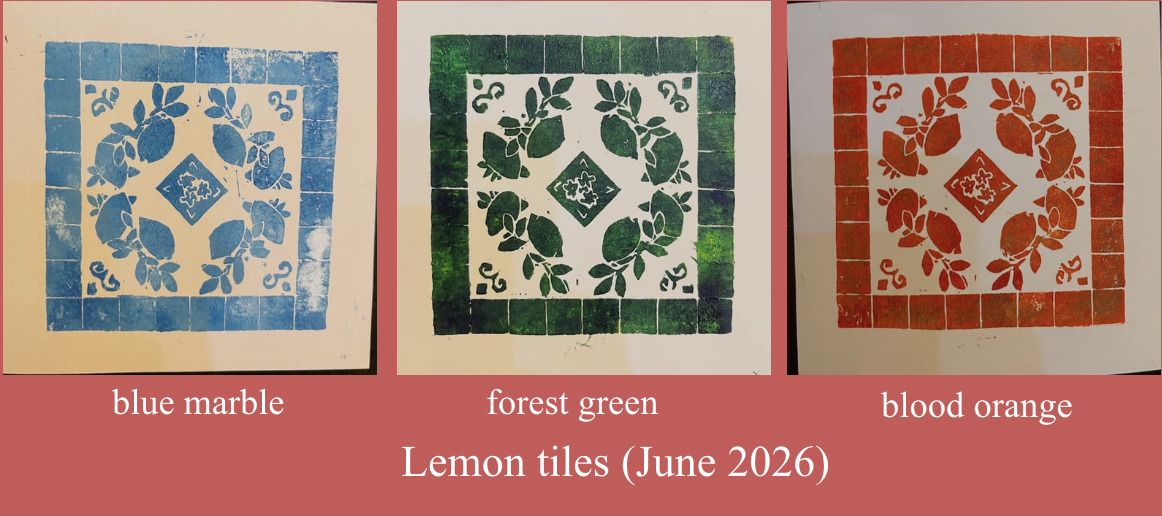
And knew what I had to do with them:
I took them into Pixelmator Pro, cropped them as closely together as I could, colour graded them to get them as close to their respective colour channel as possible, masked out the non-inked sections, and stacked the 3 channels as layers which linear dodge down to a black background, since RGB is additive. Next time, I might consider trying to get CMYK instead, to avoid having to mask out the non-inked areas.
I showed my Pixelmator document to my wife, who thought it was very interesting, so I decided to see how far it could be taken. My first step was to implement it in Javascript, which is what’s embedded above. We put that on my wife’s website: willowtree.mmm.page/prints. This was fun, but once I built that, I asked myself if I could make it cycle through the colours. That was accomplished without much hassle as well. I’d been thinking about attempting some new projects for a while, so I decided to see it out even further, and picked up a cheap yellow esp32 display online. To get it into firmware was similarly simple, this type of work is pretty standard for most computers nowadays it seems. I made some nicer UI elements for it, wrote some code to determine a colour ‘name’ based on the current mix, refined the mix to avoid bad looking combos, and threw the whole thing together.
I really loved working on this project, but the real highlight was getting to do a creative project with my wife. It brought us closer together in a fun and relaxing way, and we both love the result. We still haven’t decided what to do with the actual hardware device, but the code is live on both of our websites now. I still think my wife’s linocut is doing the heavy lifting but the hardware and web components were a fun easy build, and I came away wanting to make more.